

Model Law on Health Data Governance
A blueprint for strengthening national legislation
Transform Health and partners, including the Asia eHealth Information Network (AeHIN), Pan African Health Informatics Network (HELINA), RECAINSA, Young Experts Tech for Health (YET4H), OECD and Africa CDC, have supported the development of a draft Model Law on Health Data Governance, which provides a tool for governments, and the foundation for a global and regional framework. As a template law (a blueprint and flexible framework), it offers a non-prescriptive legislative guide and resource that can be used by countries (fully or in part) to support efforts to strengthen national laws and frameworks on health data governance. It articulates core elements, legislative guidance and reference legal text that can suit the legal systems of different countries.
The model law is informed by the Health Data Governance Principles and draws inspiration from the national legislative and regulatory landscape reviews of more than 30 countries, among other national, regional and international instruments, commitments and best practice. It was developed through a consultative process, engaging more than 1000 stakeholders from 65 countries.
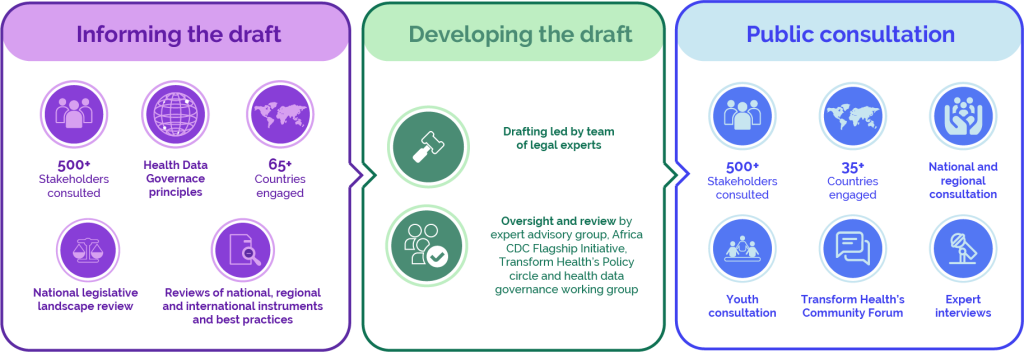
This widely consulted Model Law is a starting point for discussion amongst governments. We encourage governments to use the Model Law to support the development of a global and regional health data governance framework, for endorsement through the World Health Assembly resolution regional mechanisms, and ultimately to use it to strengthen national frameworks.
Download the ‘Model Law on Health Data Governance’
Download the the alternate version: ‘Health Data Governance Framework’
Implementation Guide
This implementation guide has been developed to support governments and other stakeholders wanting to use the Model Law (fully or in part) as a resource to strengthen national legislation and regulations.
PART A: INTRODUCTION AND HOW TO USE THE GUIDE
Key considerations when implementing the model law
In the following paragraphs, the main considerations for successfully using the model law to strengthen national frameworks are explored.
Legislative requirements
The Model Law includes suggested provisions to strengthen the legislative environment governing the collection and use of health data. The areas contained in the Model Law are intended to augment an existing data protection law or the data protection provisions within health legislation. Most countries have a data protection law or are in the process of developing one. The Model Law provisions would introduce new important areas (for example, on emerging developments in digital health systems and community consent) to strengthen the law, to allow for the Regulator to deal with health data governance issues as well. If your country is in the process of drafting a data protection law, then the model law provisions can be incorporated into the process relatively seamlessly. If your country does not have a data protection law and is also not in the process of drafting one, then you will be able to consider not only data protection but also health data governance when considering how to regulate personal data and health data and the model law can serve as a reference to guide your legislative activities in this regard.
Laws dealing with health professions, health facilities, cybercrime, cybersecurity and electronic transactions would be advantageous to effectively using the Model Law but are not necessarily required.
Institutional requirements
The Model Law was developed on the premise that a country already has a body responsible for overseeing and enforcing that country’s data protection law, and that this body is functional. This body, referred to in the Model Law as the ‘Regulator’, should be adequately funded, with sufficient capacity, to fulfil its mandate. In cases where a country does not have a dedicated body, the implementation and enforcement of relevant laws and provisions can be incorporated into the functions of an existing institution, such as the information technology regulator.
Political requirements
The political will to strengthen legislation dealing with the governance of health data is vital. Care should be taken to avoid making the strengthening of health data governance legislation a partisan issue. The focus should be on the benefits that a more robust legislative environment has on users, the healthcare sector, the public, and even the economy.
Human capacity requirements
Data protection law is itself a legal speciality and health data governance is a sub-speciality of this. Countries that are new to implementing data protection legislation should consider strategies to identify and train the required human capacity for successful strengthening and implementation of health data legislation.
Health infrastructure requirements
The Model Law and its provisions are primarily concerned with health data that has been digitised and so if the necessary digital infrastructure is lacking (for instance access to the Internet is not widely available) then implementing some of the model law provisions may be difficult. There are substantial resources to assist countries to evaluate their health data infrastructure.
Preparation before Implementation
Before the model law is used as a tool to strengthen national legislation, the following steps should be followed:
Review laws and regulations
Review the national legislative and regulatory landscape as it relates to the governance of health data. The Health Data Governance Legislative Assessment Tool
Assess gaps
Assess gaps in national legislation and regulations vis-vis provisions in the model law to identify areas that should be strengthened (whether that be existing legislation or where new laws are needed).
Map needs
Based on the identified gaps and areas of national legislation that should be strengthened, use the relevant sections in section B of this Implementation Guide (which detail how different sections of the model law can be used and incorporated to strengthen national legislation) to map out what is needed.
Identify roles and responsibilities
Identify and engage stakeholders that need to be involved (Responsible, Accountable, Consulted, Informed) to update or develop new legislation or regulations, to secure stakeholder buy-in and ownership.
Develop roadmap
Develop a national roadmap to take forward the development and/or updating of national laws and regulations, including outlining actions, roles and responsibilities, and timelines, as well as needed capacity, financial resources and other structures that would need to be established. Secure wide stakeholder buy-in around the roadmap.
Implement roadmap
Implement the national roadmap to strengthen national laws and regulations.
Review implementation
Monitor and review implementation of the roadmap.
Implementation methods
There are many ways in which the Model Law can be used to support countries to strengthen their national legislation dealing with the governance of health data. The choice of implementation method will depend on many of the factors that have been listed in the previous section. The most pertinent advantages and disadvantages of each implementation method are highlighted. This section does not attempt to fully explore the implications of each method.
Single law implementation method
The single law implementation method involves enacting a comprehensive, unified legal framework to govern all aspects of health data. If taking this approach, all sections of the Model Law could be useful. This could also mean enacting the Model Law as it is as a single law. This approach consolidates various aspects of health data governance, such as community consent, interoperability requirements and pandemic responses, under one central piece of legislation. This method simplifies compliance by providing a single point of reference for all stakeholders, including healthcare providers, data processors, and patients. It ensures uniformity across the sector, reducing ambiguity. However, the single law approach can be rigid, making it challenging to adapt to evolving technologies or sector-specific needs. It may also be more difficult to pass and amend, given the complexity of covering all aspects of health data governance in one statute.
The single law implementation method is more suitable for countries with a tradition of comprehensive and centralized legal systems, such as those following civil law traditions, where codification is the norm. These countries are better positioned to adopt a comprehensive health data governance framework that seamlessly integrates various legal provisions under one overarching law.
Multiple law implementation method
The multiple law implementation method divides the governance of health data across several laws, each addressing a specific aspect of health data. For instance, separate laws may govern patient privacy, data sharing for research, healthcare provider obligations, and data security standards. This approach allows for more specialised and focused laws and regulation addressing the unique requirements of each area. It also offers greater flexibility in updating or amending specific laws without updating the entire legal framework. However, the complexity of managing multiple laws can result in compliance challenges for stakeholders, as they must navigate different regulations that may occasionally overlap or conflict.
The multiple law implementation method would be particularly suitable for countries with established sector regulators and tailored sectoral enforcement in sectors such as healthcare, telecommunication and information technology. In this case, each sectoral regulator could oversee health data governance within its domain thereby ensuring that the law is enforced in a manner consistent with the sector’s specific requirements and existing legal frameworks. Countries with decentralised legal systems such as federations or those with strong regional governments will also find this approach easier. This is because multiple laws may be necessary to accommodate the different legal and institutional frameworks across regions or sectors. Furthermore, in countries where there are constraints, such as limited technical or human resources, making it difficult to implement the law comprehensively all at once, a multiple law approach becomes more suitable. This method offers flexibility by allowing for the phased implementation of the model law, enabling the country to address specific areas gradually as capacity builds over time.
Sandbox environment / use-case testing implementation method
The sandbox environment implementation method creates a controlled, experimental environment where new regulations, technologies, or health data governance models can be tested before full-scale implementation. This method allows policymakers and stakeholders to explore the impacts of specific regulations on health data usage without the risk of widespread disruption. It fosters innovation by providing a space for regulatory experimentation, allowing both regulators and industry players to better understand the implications of new frameworks. However, sandboxes require careful oversight to ensure that participant activities remain within agreed boundaries and do not negatively affect patient privacy or data security.
Several factors could make the sandbox environment implementation method a preferred initial choice for countries. These include an uncertain or evolving regulatory landscape, where experimentation is needed before full implementation. Countries with an innovative digital health sector may choose this approach to foster innovation while managing regulatory risks. Additionally, in cases of significant resource constraints, countries might prefer starting with a pilot project, like the sandbox method, before committing to a comprehensive implementation. Finally, this method is more suitable for smaller countries with massive institutional support and a good regulator as well as corporate sponsorship.
Incremental implementation method
The incremental implementation method involves the gradual rollout of a health data governance framework over time. Laws or regulations are introduced in phases, allowing for progressive adaptation by healthcare providers, data processors, and other stakeholders. This method is particularly beneficial in jurisdictions where immediate large-scale changes may be disruptive or where healthcare systems are unevenly developed. By implementing changes incrementally, governments can gather feedback, assess challenges, and adjust before advancing to the next phase. However, this approach requires robust project management and may lead to delays or inconsistencies if not carefully managed.
A country may prefer an incremental implementation method when faced with a complex regulatory environment, as this approach allows for gradual adjustments based on stakeholder feedback. It is particularly suitable for countries with limited administrative capacity, enabling them to manage resources effectively without overwhelming existing systems. Additionally, the incremental method fosters stakeholder engagement and consensus-building, ensuring that privacy concerns are adequately addressed at each stage. This flexibility allows for tailoring regulations to the specific needs and contexts of the country, making it a pragmatic choice over other implementation methods.
Hybrid implementation method
The hybrid implementation method combines elements of the single and multiple law approaches. A foundational, overarching law may be enacted to establish key principles and rights concerning health data governance, while more specific, sector-focused regulations are implemented separately to address particular issues like data sharing for research, cross-border data transfers, or health data security. This method provides a balance between coherence and flexibility, ensuring that general principles apply universally, while allowing for specialised regulations to be tailored to different sectors or issues. It can, however, be complex to administer, and ensuring that the various laws and regulations are consistent and cohesive requires strong coordination.
The hybrid implementation method is a worthy candidate for a country under specific conditions, such as the need for flexibility in combining regulatory approaches to address diverse challenges. This method is advantageous in environments with varying levels of digital health maturity, allowing tailored strategies for different sectors. Additionally, countries facing both resource constraints and the need for innovation may find this approach beneficial, as it facilitates incremental changes while also enabling pilot projects.
Subsidiary legislation method
The subsidiary legislation method relies on primary health data governance laws, but delegates authority to administrative bodies to create detailed regulations, guidelines, or codes of practice through secondary or delegated legislation. This method allows for greater adaptability and responsiveness to emerging issues or technological developments. Subsidiary legislation is typically easier to amend than primary laws, enabling faster updates to specific regulations as needed. However, this approach depends heavily on the competency and capacity of the regulatory bodies tasked with developing the subsidiary legislation. Additionally, it may lead to inconsistencies if these bodies produce regulations that conflict with broader legislative objectives or each other.
A country might prefer a subsidiary legislation model if it seeks to provide detailed regulations tailored to specific contexts, ensure flexibility in updating rules without passing new primary legislation, leverage existing legal frameworks for quicker implementation, and address the specific needs of different healthcare sectors or regions. However, this implementation method may be impossible to implement if the primary legislation does not enable the regulatory bodies to create the subsidiary legislation that is required by this method. As a result, it may be necessary to amend the primary legislation first before this method is legally possible.
PART B: HOW TO USE AND INCORPORATE SECTIONS OF THE MODEL LAW
This section of the implementation guide looks at specific sections of the model law and how they can be used and incorporated to strengthen national frameworks.
Purpose
The intention of this section is to articulate the foundational principles and objectives of the model law. These foundational principles and objectives, and implementation guidance below, can be considered and applied widely when strengthening the national legislative landscape dealing with the governance of health data, whether those entail updating current laws or developing new ones. These are foundational principles and objectives are therefore not limited to countries developing a whole new health data governance law.
Definitions
Scope
The scope section of the model law delineates the extent and boundaries of the law’s applicability. By specifying who and what is covered under the law, this section ensures that all relevant individuals, entities, and types of data are included in the legal framework, thereby providing comprehensive governance over health data. The section covers a wide range of activities related to health data, from collection to disposal, and applies to both digital and non-digital formats, ensuring that the law remains relevant in various contexts and mediums.
Exclusions
The exclusions section of the model law outlines specific circumstances where the law does not apply. By delineating these exclusions, the law acknowledges situations where the governance of health data might either be inappropriate or already adequately covered by other legal frameworks. This section helps to ensure that the law is focused on relevant activities and does not overextend into areas where its application could be unnecessary or counterproductive.
Interpretation
The interpretation section of the model law clarifies the intended meaning of certain terms and provisions used within the law. By providing explicit guidelines on how to understand key elements, this section helps prevent misinterpretation and ensures that the law is applied consistently and effectively across various contexts.
Health Data Court
The establishment of the Health Data Court under the model law is a critical component designed to provide a specialized judicial forum for adjudicating matters related to the governance, use, and protection of health data within the relevant country. By creating a dedicated court with specific expertise in health data management, law, ethics, and technology, this model law ensures that disputes arising from the use and handling of health data are resolved in a fair, transparent, and efficient manner. The Health Data Court serves as the central authority for enforcing the provisions of this law, ensuring that all stakeholders, including individuals, communities, data controllers, and holders of proprietary rights in digital instances containing health data, are held accountable to the highest standards of legal and ethical conduct.
Individual Rights; Portability of Electronic Medical Records
The focus of this section is to reinforce the privacy rights of individuals concerning their personal health data while going further by addressing the specific needs and challenges associated with the digital management of health information. One of the key extensions provided by this section is the right to portability of electronic medical records (EMRs). In an era where health data is increasingly stored and transferred electronically, the right to portability is vital for empowering individuals to manage their health information more effectively.
Prohibition on Re-identification
This section establishes a critical safeguard in the governance of health data by prohibiting the re-identification of individuals from anonymised or pseudonymised health data. Anonymisation and pseudonymisation are key techniques used to protect individuals’ privacy by removing or masking personally identifiable information from datasets. However, as data analytics and technology advance, the risk of re-identifying individuals from such datasets increases, potentially compromising privacy and leading to unintended consequences.
Communities’ Rights in their Community Health Data
This section establishes the legal framework for recognizing and protecting the rights of communities in relation to their collective health data. The section ensures that communities have a formal, recognized role in the management and decision-making processes concerning their community health data, thus safeguarding their collective interests.
Rights and Obligations of Health Data Generators; Open Access to be Provided by the State
This section establishes the legal framework for recognizing the rights and obligations of health data generators, as well as the state’s role in ensuring open access to non-identifying health data for the benefit of the public. By formalizing the concept of proprietary rights in health data instances, the section incentivizes the collection and generation of health data while also setting clear boundaries to ensure that these rights do not infringe upon individual privacy or community rights.
Using Health Data in the Public Interest
The purpose of this section is to establish a legal framework that allows for the use of health data in situations where it serves the public interest, even when such data is held under proprietary rights by a health data proprietor. This section is akin to the concept of compulsory licensing in patent law, where an entity may be granted the right to use a patented invention without the consent of the patent holder, typically in cases where the use is deemed essential for the public good.
Pandemics and Other Health Emergencies
The purpose of this section is to facilitate the incorporation and implementation of the Pandemic Prevention, Preparedness and Response Instrument (the “Instrument”) into domestic law once it has been ratified by the relevant country. The Instrument, drafted and negotiated by the intergovernmental negotiating body, aims to enhance global health security by establishing comprehensive guidelines and obligations for countries to better prevent, prepare for, and respond to pandemics and other health emergencies. This section ensures that the relevant country aligns its domestic legal framework with international standards as set forth in the Instrument, and that any necessary adjustments are made to existing legislation and policies to ensure compliance.
Emerging Technologies
This section of the model law addresses the integration and regulation of emerging technologies in healthcare, focusing on safeguarding the rights of individuals and communities whose health data is collected, processed, or used by such technologies. As healthcare increasingly relies on advanced technologies such as artificial intelligence, machine learning, and big data analytics, it is imperative to ensure that these technologies are deployed in a manner that respects privacy, promotes equity, mitigates bias, and maintains transparency.
Feedback, Confidentiality, and Protection of Whistle-Blowers
This section establishes critical protections and mechanisms for reporting illegal or unethical use of health data, unauthorized re-identification, and other concerns related to the model law. By ensuring that individuals can report such issues confidentially and without fear of retaliation, this section upholds the integrity of health data governance and promotes accountability among those who handle health data.
Offences
This section outlines specific acts or omissions that are subject to criminal sanctions. To ensure responsible handling of health data and protect it from misuse, the law classifies certain actions or omissions as criminal offences, thereby promoting a high level of compliance. Anyone who engages in these prohibited acts or fails to act as required is deemed guilty of an offence, which triggers the corresponding criminal penalties specified in the model law. This provision ensures that the model law is not merely a symbolic declaration of rights and duties but is reinforced with appropriate sanctions to ensure adherence to its provisions. Moreover, this section aligns with international principles of criminal law, which stipulate that only those acts explicitly defined in written law, along with their corresponding penalties, can be recognised as punishable offences.
Penalties
This section establishes a framework for penalizing the offences identified in the preceding section thereby ensuring that breaches are addressed through a range of possible sanctions. A law is considered incomplete if it merely defines an offence without specifying the corresponding punishment. By providing clear penalties, this section ensures that the enforcement and prosecution of offences under the law are both just and legally sound. Additionally, it promotes certainty in the application of the provision of the model law.
Subsidiary Legislation
Section 17 acknowledges the critical role of subsidiary legislation in the effective implementation of the Model Law, particularly in areas where rapid technological advancements create a dynamic legal landscape. As digital technologies and data processing methods evolve at an unprecedented pace, the static nature of primary legislation may struggle to adequately address emerging issues or provide sufficient detail in specific areas. Subsidiary legislation serves as a vital mechanism to bridge this gap, enabling the law to remain adaptable and responsive to technological developments. By allowing for the creation of detailed regulations and guidelines under the broader framework of the Model Law, section 17 guarantees that the legal infrastructure can evolve in tandem with technological innovation, thereby enhancing the overall effectiveness of data governance in practice. This approach not only strengthens the legal framework but also ensures that the principles enshrined in the Model Law are operationalised in a manner that is both timely and contextually relevant.
Review
This section guarantees that the law remains not only relevant and effective but also adaptable and responsive to technological advancements and societal changes over time, thereby maintaining its efficacy in an evolving landscape.
Transitional Provisions
This section is designed to ensure that any amendments to the law are implemented in a manner that minimizes disruption for all stakeholders, including data controllers, individuals, and communities. It provides comprehensive legal guidance and establishes clear processes for managing the transition from the existing legal framework to the newly established regime. By doing so, it aims to facilitate compliance and protect the rights and interests of those impacted by the legal changes. Additionally, this section is crafted to prevent any legal or procedural gaps from arising during the transition, thereby ensuring a seamless shift from the old to the new legal order.
Short Title and Commencement
This section establishes a clear and formal identification of the law and outlines when it will take effect. The section serves several useful purposes including clarity, legal formality and legal basis/legitimacy.